![]() |
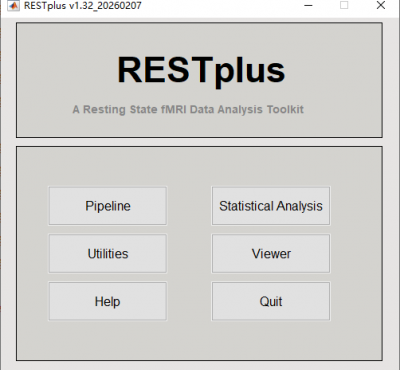
Resting-State fMRI Data Analysis Toolkit (REST) is a convenient toolkit to calculate Functional Connectivity (FC), Regional Homogeneity (ReHo), Amplitude of Low-Frequency Fluctuation (ALFF), Fractional ALFF (fALFF), Gragner causality, degree centrality, voxel-mirrored homotopic connectivity (VMHC) and perform statistical analysis. You also can use REST to view your data, perform Monte Carlo simulation similar to AlphaSim in AFNI, perform Gaussian random field theory multiple comparison correction like easythresh in FSL, calculate your images, regress out covariates, extract ROI time courses, reslice images, and sort DICOM files. Download a MULTIMEDIA COURSE would be helpful for knowing more about how to use this software. Add REST's directory to MATLAB's path and enter "REST" in the command window of MATLAB to enjoy it. The latest release is REST_V1.8_130303. |
New features of REST V1.8 release 130303:
When calling Mingrui Xia's BrainNet Viewer (http://www.nitrc.org/projects/bnv/), the default surface template is changed to the smoothed version (BrainMesh_ICBM152_smoothed.nv). The previous default template (BrainMesh_ICBM152.nv) hide more information in the sulcus. If the users want to use BrainMesh_ICBM152.nv as default surface template, please uncomment Line 3740 in rest_sliceviewer: %SurfFileName=[BrainNetViewerPath,filesep,'Data',filesep,'SurfTemplate',filesep,'BrainMesh_ICBM152.nv'];
(After discussion with Mingrui Xia).
New features of REST V1.8 release 130214:
1. This release fixed some minor bugs, will not affect any data analysis.
2. Fixed a bug when using .nii(.gz) files in REST Image Calculator. (WANG Xin-Di)
3. Fixed a bug in using .nii(.gz) files in GCA analyses. (ZANG Zhen-Xiang)
4. Fixed the imresize_old bug of REST Slice Viewer with Matlab 2012b. (YAN Chao-Gan)
New features of REST V1.8 release 121225:
1. Support parallel computing! If you installed the MATLAB parallel computing toolbox, REST can distribute the subjects into different CPU cores. (WANG Xin-Di and YAN Chao-Gan).
2. Algorithm change: (1) Filtering: a separate function for matrix filtering was written. The low cutoff frequency index calculation changed from round (in REST V1.7) to "ceil". E.g., if low cut off corresponded to index 5.1, now it will start from 6 other than 5. This change also applies to ALFF and fALFF calculation. The filtered data changes slightly, about 0.0001. (2) The ALFF generated by the new version is sqrt(2/N) times of the original version. (new version used: 2*abs(fft(x))/N; original version used: sqrt(2*abs(fft(x))^2/N)). This change will not affect group analysis (as each individual scaled the same number), and will not affect mALFF and fALFF calculation as this factor will be normalized. (3) In the calculation of ReHo, the rank will keep as double and no longer converted into uint16, thus created slight difference with REST V1.7. (YAN Chao-Gan)
3. REST Slice Viewer support 4D file display and the maximum and minimum value could be set. (WANG Xin-Di)
4. Gaussian random field (GRF) theory multiple comparison correction (like easythresh in FSL) was supported. The smoothness could be evaluated for GRF correction or AlphaSim correction. (GUI by WANG Xin-Di, algorithm by YAN Chao-Gan)
5. Modules of voxel-mirrored homotopic connectivity (VMHC) (Zuo et al., 2010), Degree Centrality (Buckner et al., 2009) were added. (GUI by WANG Xin-Di, algorithm by YAN Chao-Gan)
6. REST GCA: could handle multiple ROIs (other than 2) in ROI-wise GCA now. Fixed a bug of discordance between the outputs and the description in REST-GCA readme in the pre-release of REST V1.8. (ZANG Zhen-Xiang)
7. rest_readfile.m and rest_writefile: The default format changed to .nii from .img. (WANG Xin-Di)
8. rest_to4d.m: now support one 4d file other than a directory, also support a cell of image filenames. (YAN Chao-Gan)
9. rest_regress_ss.m: add the output of T value. (YAN Chao-Gan)
10. rest_Write4DNIfTI.m: This function was added for write 4D nifti files based on SPM’s nifti function. (YAN Chao-Gan)
11. rest_writefile.m: No longer need to change to RPI before writing. (YAN Chao-Gan)
![]() |
Data Processing Assistant for Resting-State fMRI (DPARSF) is a convenient plug-in software based on SPM and REST. You just need to arrange your DICOM files, and click a few buttons to set parameters, DPARSF will then give all the preprocessed (slice timing, realign, normalize, smooth) data, functional connectivity, ReHo, ALFF/fALFF, degree centrality, voxel-mirrored homotopic connectivity (VMHC) results. DPARSF can also create a report for excluding subjects with excessive head motion and generate a set of pictures for easily checking the effect of normalization. You can use DPARSF to extract ROI time courses efficiently if you want to perform small-world analysis. DPARSF basic edition is very easy to use while DPARSF advanced edition (alias: DPARSFA) is much more flexible and powerful. DPARSFA can parallel the computation for each subject, and can be used to reorient your images interactively or define regions of interest interactively. You can skip or combine the processing steps in DPARSF advanced edition freely. Please download a MULTIMEDIA COURSE to know more about how to use this software. Add DPARSF's directory to MATLAB's path and enter "DPARSF" or "DPARSFA" in the command window to enjoy DPARSF basic edition or advanced edition. The latest release is DPARSF_V2.2_130309. |
New features of DPARSF_V2.2_130309:
1. Advanced Edition: Fixed a bug in "Smooth by DARTEL" caused in previous revision (DPARSF_V2.2_130214). (Thanks for the report of Maki Koyama).
New features of DPARSF_V2.2_130303:
1. Advanced Edition: Fixed a bug in processing of multiple sessions - only process the last session in normalization and smooth.
2. Basic Edition: Fixed a bug caused in the previous release (V2.2_130214) - cannot load the correct masks (Thanks for the report of Tao Yang).
New features of DPARSF_V2.2_130224:
1. This release fixed some minor bugs, but will not affect the results of any data analysis. The bugs appear in uncommon parameter settings and stop the processing in the worst cases.
2. Updated the DPARSFVersion information in the template parameter files.
3. DPARSF basic edition will also output the results of ReHo/ALFF/fALFF after Z-standardization (subtract the whole brain mean and divide by the whole brain standard deviation).
4. Fixed a bug in nuisance covariates regression when CovMat is not defined.
5. Fixed a bug that can not save the ROI signals correctly in text file if the data is not in double format. (Thanks for the report by H. Baetschmann)
6. Fixed a bug in creating mean functional image for 4D files. (Thanks for the report and revision by S. Orsolini)
7. Fixed a bug in displaying ROI Templates in linux system. (Thanks for the report by Han Zhang)
New features of DPARSF_V2.2_121225:
1. Support parallel computing! If you installed the MATLAB parallel computing toolbox, you can set the number of "Parallel Workers", DPARSFA will distribute the subjects into different CPU cores.
2. In addressing head motion concerns in resting-state fMRI analyses (Power et al., 2012; Satterthwaite et al., 2012; Van Dijk et al., 2012), we provide Friston 24-parameter correction (See Yan et al., 2013 for a comprehensive assessment of head motion on functional connectomics) as well as voxel-specific head motion calculation and correction (Satterthwaite et al., 2013; Yan et al., 2013). DPARSF also calculate the voxel-specific mean framewise displacement (FD) and volume-level mean FD (Power) (Power et al., 2012) or FD (Jenkinson) (i.e., relative RMS; Jenkinson et al., 2002) for accounting head motion at group-level analysis. The data scrubbing approach is also supported with different methods: 1) model each bad time point as a separate regressor in nuisance covariates regression, 2) delete bad time points, 3) interpolate bad time points with nearest neighbor, linear or cubic spline interpolation.
3. According to (Weissenbacher et al., 2009), the nuisance covariate regression could be performed before filtering and at very early stage. Users can also choose Template Parameters: TRADITIONAL order to have the same order as the previous version.
4. Support .nii.gz in all the steps. No longer need to convert 4D .nii.gz into 3D .img/.hdr. Simply put .nii.gz under FunImg or any starting directory name, DPARSFA will handle the .nii.gz by itself.
5. If the Number of Time Points is set to 0, then DPARSFA will not check the number of time points.
6. If TR is set to 0, then DPARSFA will retrieve the TR information from the NIfTI images. Please ensure the TR information in NIfTI images are correct!
7. If Slice Number is set to 0, then retrieve the slice number from the NIfTI images. The slice order is then assumed as interleaved scanning: [1:2:SliceNumber, 2:2:SliceNumber]. The reference slice is set to the slice acquired at the middle time point, i.e., ceil(SliceNumber/2). SHOULD BE EXTREMELY CAUTIOUS!!!
8. Support calculating resting-state fMRI metrics in native space and warping by DARTEL. The mask files and/or region of interest (ROI) files in standard space are warped into native space by using the parameters estimated in segmentation or DARTEL.
9. Spatial normalization and smooth can be performed on the calculated resting-state fMRI derivatives.
10. Supporting extracting ROI time course using masks with multiple labels. More template ROI definitions are supported: Dosenbach’s 160 functional ROIs (Dosenbach et al., 2010), Andrews-Hanna’s default mode network ROIs (Andrews-Hanna et al., 2010), Craddock’s clustering ROIs (Craddock et al., 2011), AAL atlas and Harvard-Oxford atlas.
11. More resting-state fMRI metrics are included, e.g., voxel-mirrored homotopic connectivity (VMHC) (Zuo et al., 2010), Degree Centrality (Buckner et al., 2009) and connectome-wide association studies based on multivariate distance matrix regression (Shehzad et al., 2011).
12. For VMHC analyses, support normalizing the data further to a symmetric template. 1) Get the T1 images in MNI space (e.g., wco*.img or wco*.nii under T1ImgNewSegment or T1ImgSegment) for each subject, and then create a mean T1 image template (averaged across all the subjects). 2) Create a symmetric T1 template by averaging the mean T1 template (created in Step 1) with it's flipped version (flipped over x axis). 3) Normalize the T1 image in MNI space (e.g., wco*.img or wco*.nii under T1ImgNewSegment or T1ImgSegment) for each subject to the symmetric T1 template (created in Step 2), and apply the transformations to the functional data (which have been normalized to MNI space beforehand). Please see a reference from Zuo et al., 2010.
13. A group analyses function was added as y_GroupAnalysis_Image by scripting call. T tests or F tests could be performed for a given set of regressors.
14. Template Parameters:
Calculate in Original Space (warp by DARTEL)
Calculate in Original Space (warp by information from unified segmentation)
Calculate in MNI Space (warp by DARTEL)
Calculate in MNI Space (warp by information from unified segmentation)
Calculate in MNI Space: TRADITIONAL order [This is the order used in DPARSF basie edition as well as DPARSFA V2.1]
Intraoperative Processing
Task fMRI data preprocessing
VBM (New Segment and DARTEL)
VBM (unified segmentation)
Blank
Many thanks to Dr. Chris Rorden for suggesting features 4-7. Many thanks to Dr. Susan Whitfield-Gabrieli for discussing the head motion scrubbing regressors.
Hello,
just a general Functional Connectivity / ROI question: is there something like a "minimum size" required for a ROI to perform valid statistics? Would like to know your opinion on that.
Best,
K
Dear Dr. Yan,
I have read your recent paper in Neuroimage about head motion, very informative. I have serveral questions:
1)The whiskers bar figures present your results very clear. It looks better than the traditional whiskers bar.
严老师,我在用dparsf时有warning和报错如下,请您指导一下是哪块出了问题
Warning: Invalid escape sequence appears in format string. See help sprintf for valid
escape sequences.
> In rest_detrend at 24
In DPARSFA_run>(parfor body) at 2265
In parallel_function at 469
In DPARSFA_run at 2264
In DPARSFA>pushbuttonRun_Callback at 1579
Hi, admistrator
first, above all, thank you for providing your program
Our researchers have studied ADHD adolescent and their brain activity used in fMRI.
Our study is block design and I have analysed this by using SPM8.
各位老师好!最近在处理一批病人的数据,头动较大(放宽至3mm和3°)的被试比较多,但是被试的总体数量又比较少。想请问一下各位老师有没有对头动的被试的处理的方法。
暂时有两个想法:1.去掉头动较大的时间点。2.不去头动的被试,最后将头动作为协变量去掉。暂时只是这样想,还没有找到文献的依据,不知道具体可不可行,还请老师指点,多谢!
Hi, I have been using DPARSFA for preprocessing and it has been working very well so far. I tried to remove the Global Signal nuisance regressor, but after doing so my data has no voxels left -- i.e., when I enter it into a first-level model in SPM, and estimate the model, I get this popup message:
-----
No inmask voxels - empty analysis!
-----
Dear REST experts,
i have performed the preprocessing of my rest fMRI data followed by the ReHo processing. after running the analysis, i have the rest ReHo*.* image, but this image is empty, can anyone suggest me where could i have made mistake (preprocessed image - smmothed image is looking fine)
